–
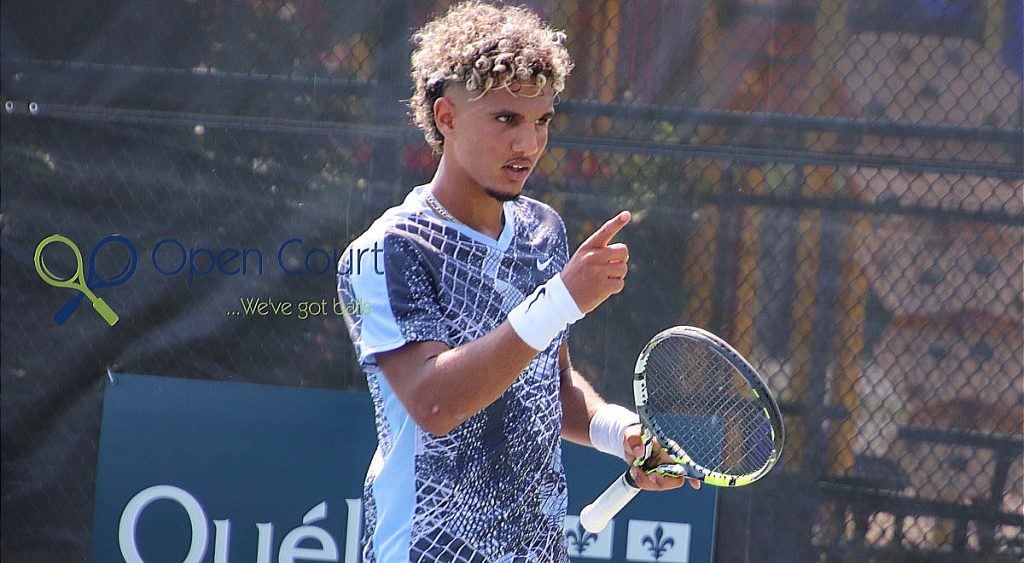
It was a long. winding road to get there for Taha Baadi.
But the 24-year-old, who hails from Laval, won his first career ATP Tour singles match on Monday at the 250 event in Marrakech, Morocco.
Baadi, who played at the southern Canadian outpost known as the University of Kentucky for several years (among the UK alumni are Liam Draxl and Gabriel Diallo), is currently ranked No. 587, down a bit from a career high of No. 560 last November.
On Monday, he faced Aussie Aleksandar Vukic, a 29-year-old currently ranked No. 84 but ranked inside the top 50 a couple of years ago. Baadi beat him 6-2, 3-6, 6-1 to advance to a second-round encounter with mercurial Frenchman Corentin Moutet.
As you can see, it was huge. He’s the first Moroccan to win a singles match at the Marrakech event in eight years, too. And he brought good karma; Karim Bennani, ranked No. 831, followed with a win of his own against the solid Quentin Halys.
TB LFG!!!! https://t.co/tjsRo6GmEP
— Alafia Ayeni (@AlafiaAyeni) March 30, 2026
Baadi is … demonstrative out there as well, and will have the home crowd. So that one against Moutet should be worth tuning in for.
Yes, the home crowd in Morocco for the kid from Laval.
So … that’s a story.
Former National Centre athlete
Baadi was once a part of the national training program based in Montreal.
He was a late arrival, only taking full advantage of it in his final year of junior eligibility. Before that, he trained in Laval at the Tennis 13 club.
But he was able to play a ton of top-level junior events, notably a South American swing on clay and a number of clay-court events in Europe leading up to his junior Grand Slam debut at Roland Garros in 2019.
What we remember about this debut, a three-set win over French kid Lilian Marmousez, was that the entire (large) Tennis Canada braintrust was on hand to support. Even Félix Auger-Aliassime, who knows Baadi from the centre, stopped in to watch.
But after it was over, Draxl was still playing a few courts down on Court 14 facing an even better French kid named Arthur Cazaux.
(Cazaux, 16 then and 23 now, is currently in the top 70).
But almost no one from the Tennis Canada crew took the quick walk two courts down to support Draxl. He was not part of the development program, even though he did play for Canada at the World Junior Finals in Chengdu late that year. He had his own setup, with father Brian, a tennis coach, at the helm.
It was an interesting year for Canadian juniors, who were more plentiful back then at the junior Slam level than they have been in recent years. Leylah Fernandez was constantly trying to get more support, but with father Jorge being the coach, ran up against a a few brick walls. She won the girls’ singles that year. Fernandez played doubles with Mélodie Collard, who was from the Outaouais and also had her own coaching setup. As did Draxl. Baadi, in that one year, was the only one officially under the umbrella.
Baadi upset Giulio Zeppieri (who has gotten as high as No. 110 on the ATP Tour two years ago) in the second round.
He was beaten in the quarterfinals by American Toby Kodat, who as it happens is the half-brother of former WTA top 10 Nicole Vaidisova.
Baadi also made the third round at junior Wimbledon.
At the 2019 junior US Open, Draxl, Baadi and Collard represented Canada.
Baadi’s junior eligibility expired at the end of that season; he got as high as No. 31 in the world.
From juniors, to college, to the pros
After putting off the decision for a short period, Baadi ended up at Wake Forest in Jan. 2020, playing three years there before transferring to the University of Kentucky and playing his senior season, as well as a fifth year made possible by the pandemic disruption.
It’s only been since then that he’s going out and tried to make it in the pros on a full-time basis. And full-time is underplaying it; since the spring of 2024 he has played virtually non-stop.
But when you’re playing ITFs, it’s really hard to make a move.
Changing nationalities – the Canadian way
The national federation has, at times, been supportive of players making the transition to the pros – notably early on, with Steven Diez (an import from Spain), Vasek Pospisil and Milos Raonic, to whom they supplied coaching help and other assistance.
But for the players who went the college route, it’s been tougher. We absolutely get it; support dollars aren’t unlimited and you have to make choices. But in a tennis country that doesn’t have a deep pool of players, overlooking those who don’t fit the criteria will mean you miss opportunities.
Gabriel Diallo, now a solid No. 3 Canadian on the ATP Tour, was another kid who didn’t get much traction from the federation as a junior. He was growing into his 6-8 frame, and was always injured. It was only when he went the college route that the late bloomer finally blossomed; suddenly, he was in favour again. (Diallo, whose father fis Guinean and whose mother hails from Ukraine, has never indicated any interest in switching nationalities).
Erin Routliffe, who went through the national program for several years, ended up choosing to represent New Zealand (where she was born before returning to her parents’ native Canada as a toddler) because there were more opportunities. As someone whose career path was clearly going to be in doubles, she didn’t trip the support meter. Routliffe ended up becoming No. 1 in the world and winning two Grand Slam titles with Gabriela Dabrowski before they split at the end of 2025.
What’s less clear is why they almost pretend these players don’t exist, once they opt to represent another country. They are still Canadian, and the federation had a hand in their journey – and in some cases invested quite a generous hand. You’d think they’d look to claim a little deserved credit.
The classic case in point was one photo published on social media awhile back that featured Dabrowski and … Routliffe’s right arm. Or those that show her out of focus, or from the back.
Filip Peliwo, who spent years in the national program and, in his final year of elibility won two junior Grand Slams (Wimbledon and the US Open) and made the finals in the two others (Australian Open and Roland Garros) in 2012, struggled after that to make it in the pros.
He did get a fair bit of help, based on that late junior success. But eventually, that ended. And a series of injuries and setbacks meant that he’s mostly been struggling at the ITF level, after reaching a career-high ranking of No. 161 back in 2018.
He opted to represent Poland, where his parents had returned in 2022, that same year. He spoke to Open Court back then of the structure in Poland, which rewarded players financially for match wins based on the level of tournament. Clear, cut and dried, no favoritism.
Alejandro Tabilo, whose parents are from Chile, chose to represent that country once he turned 18 after never feeling like he fit in with the national program. This, even though there were junior Grand Slams in the post Genie Bouchard/Filip Peliwo era where he was the lone Canadian representative.
Tabilo benefited from a supportive entourage in his adopted country, as well as additional opportunities for Davis Cup and United Cup.
He has three ATP Tour titles, got inside the top 20 two summers ago and has career wins over players like Novak Djokovic (twice, in Monte Carlo and Rome), Stan Wawrinka, Lorenzo Musetti, Karen Khachanov, Gaël Monfils and Andrey Rublev.
One victory = big rankings jump
Baadi, who was born in Rabat, Morocco, did get wild cards into some of the Canadian Challengers in 2024. But he finally decided to make the switch to representing Morocco in the spring of 2025, just before the Marrakech tournament.
Baadi has played Davis Cup for Morocco since last year, and received a main-draw wild card at the Marrakech event the last two years. None of those things would have happened in Canada.
On Monday, the move paid off. Just by winning one match at the ATP Tour level, Baadi’s ranking is already up more than 100 spots.
It’s been nearly seven years since he left the junior ranks; tennis players are very stubborn people.
It’s unlikely Baadi will have the same kind of pro success that Tabilo and Routliffe have enjoyed. Still, he’s another one who got away.

About Post Author

More Stories
ATP Rankings Report – As of April 20, 2026
WTA Rankings Report – As of April 20, 2026
Canucks This Week – Week ending April 26, 2026 (Monday results)